Compare the best jewellery photography machines in India for 2026: features, prices, 360° photography, lighting, software, service and ROI, before you buy.
Jewellery is one of the hardest products to photograph. Polished gold reflects everything around it, diamonds and coloured stones need controlled light to show their sparkle and true colour, and online buyers zoom in to check every detail. For a jewellery business selling online, consistent and accurate product images are not optional.
A jewellery photography machine brings the camera, lighting, turntable and software together in one controlled studio, so staff can produce catalogue images in-house instead of booking a photographer for every new collection. This guide covers the types of machine available in India, the features that matter, what they cost in 2026, which suits which business, how to work out the return on investment, and a checklist to take into any demo.
A note on where we stand: Magnic makes the EasyCLIQ range, so our own machines are in this guide, alongside the systems jewellers most often compare them with. Competitor details come from each vendor’s own public product pages.
What is a jewellery photography machine?
A jewellery photography machine is an enclosed studio built for small, reflective products. It combines four things: a camera mount or robotic camera, a controlled lighting system, one or more turntables that rotate the piece, and software that runs the shoot and processes the images.
The simplest are lightboxes that give even light and a turntable for your phone or camera. At the other end are fully automated AI studios that set the lights, move the camera, capture every angle, stack focus, remove the background and produce 360° spins and video, while a person only places the piece and presses a button.
Why jewellery needs a specialised setup
Fine gold detail
Filigree, engraving and hallmarks sit at different depths, and at close range a single frame keeps only a slice of the piece in focus. The best systems use focus stacking to keep it sharp from front to back.
Diamonds and gemstones
Stones need controlled, high-CRI light to show their true colour and sparkle. Uncontrolled light turns an emerald dull and a white diamond grey.
Reflective surfaces
Polished metal mirrors the room, the photographer and the camera. An enclosed, evenly lit studio keeps reflections clean and repeatable.
Consistent backgrounds
Marketplaces and online stores expect clean, uniform backgrounds on every listing. Automatic background removal gives you that without hours of editing.
Multiple angles and 360°
Online buyers want to see a piece from several angles, and a 360° spin answers questions a single photo cannot. Turntables and robotic camera movement make that routine.
Speed at catalogue scale
Traditional photography can take 15–30 minutes per item once setup and editing are counted. Automated studios bring that down to minutes, so new collections go online sooner.
Best jewellery photography machines in India in 2026: at a glance
These are the systems jewellers in India most often shortlist. Prices are as published by each maker; EasyCLIQ prices are in Indian rupees.
Swipe sideways to see every column →
| Machine | Best for | Camera | 360° | Automation | Published price | Support in India |
|---|---|---|---|---|---|---|
| EasyCLIQ MINI | Retail counters and small studios | Your Canon DSLR or mirrorless | Yes: top and bottom turntables | AI background removal, focus stacking, templates, 360° GIF and video | ₹1,95,000 | Made in India; on-site installation, training, service and spare parts |
| EasyCLIQ HOLO | 360° spin imagery for catalogues and showrooms | Your Canon camera | Yes: 360° spin platform, 0–10 RPM | 1-click AI background removal, focus stacking | ₹4,45,000 | Made in India; installation, service and spare parts across India |
| EasyCLIQ X1 | Jewellers and online sellers: rings to long necklaces | Your Canon DSLR or mirrorless | Yes: top and bottom turntables, 360° spin video | Robotic camera (sliders, tilt, zoom), 10 lights, AI background removal with Light Mask, focus stacking, cinematic video | ₹8,85,000 | Made in India; on-site installation, training, service and spare parts |
| EasyCLIQ X3 | Large bridal pieces and multi-category e-commerce | Your Canon DSLR or mirrorless | Yes: 60 cm turntable, up to 10 kg on the bottom plate | Robotic camera arm, 10 lights, AI background removal with Light Mask, focus stacking, cinematic video | ₹10,85,000 | Made in India; on-site installation, training, service and spare parts |
| GemLightbox Pro (GemIQ) | Rings, stones and small jewellery | Phone or GemCam | Yes | Background removal in the app; focus stacking limited | $3,697 (USD, as published) | Reseller or remote installation; warranty and spares depend on import |
| Orbitvu Micro | Compact products | Built-in or DSLR, depending on model | Yes | Software background removal, focus stacking | On request | Limited installation support; warranty and spares depend on import |
| Ortery | Studios and large catalogues | Your own Canon DSLR | Yes: turntable, optional 3D rail | Software background removal, focus stacking, robotic arm options (PhotoArm, MultiArm) | On request | Limited installation support; warranty and spares depend on import |
EasyCLIQ prices are in Indian rupees; taxes, freight and service charges extra as applicable. Competitor details are taken from each vendor’s public product pages (checked 14 September 2026) and vary by model and region. Contact us for a comparison against the exact model you are considering.
The EasyCLIQ range at a glance
All four run the same EasyCLIQ software, deliver publish-ready images in under three minutes and are made in Coimbatore. Prices exclude taxes, freight and service charges.
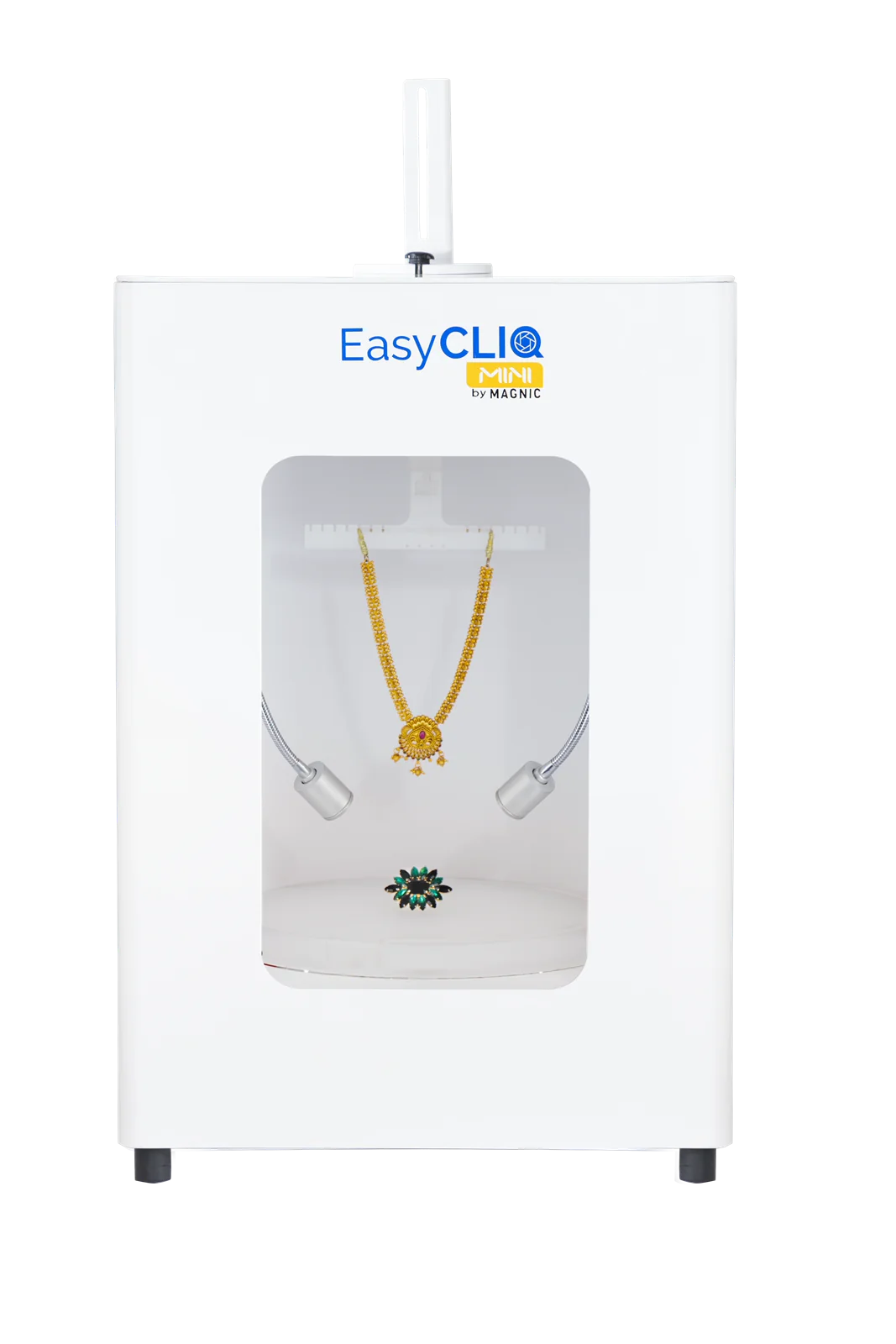
EasyCLIQ MINI: ₹1,95,000
A compact tabletop studio for retail counters, small workshops and businesses starting out. Top and bottom turntables, high-CRI lighting from 3000K to 6000K, and the same AI software as the larger models.
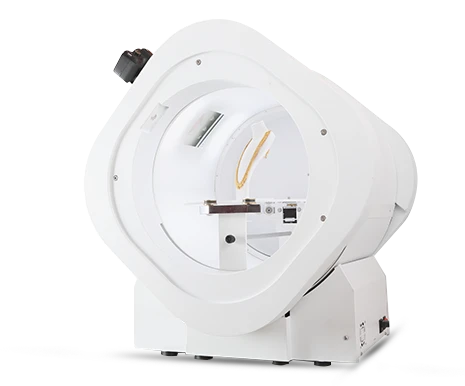
EasyCLIQ HOLO: ₹4,45,000
A dedicated 360° spin studio for catalogues, showrooms and online listings, with controllable lighting up to 25,000 lux at 90+ CRI and a 1 kg ornament load.
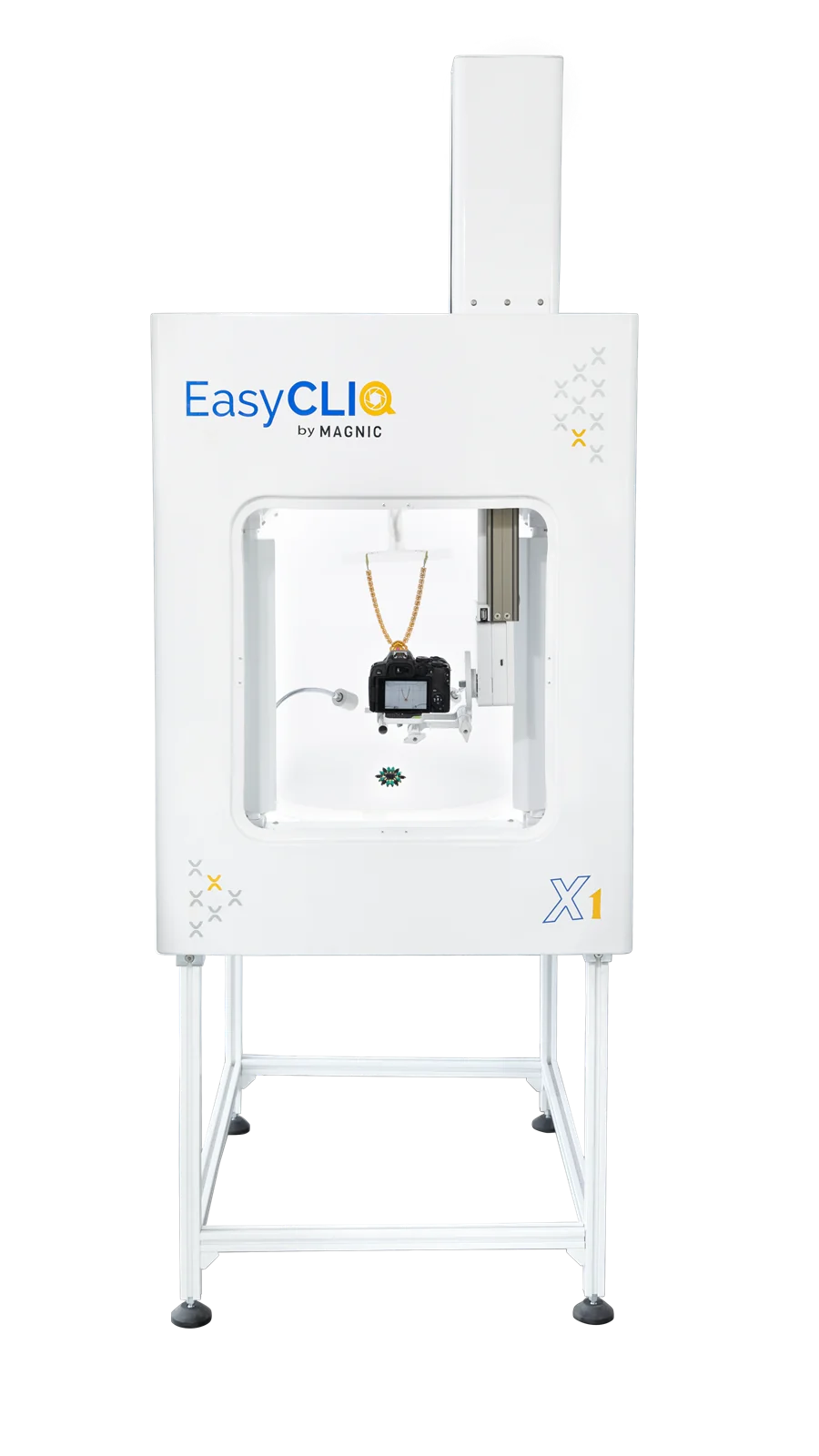
EasyCLIQ X1: ₹8,85,000
Our most popular model, the all-round robotic studio: rings to long necklaces, a robotic camera on sliders with tilt and zoom, ten independently controlled lights, and 360° spin plus cinematic video.
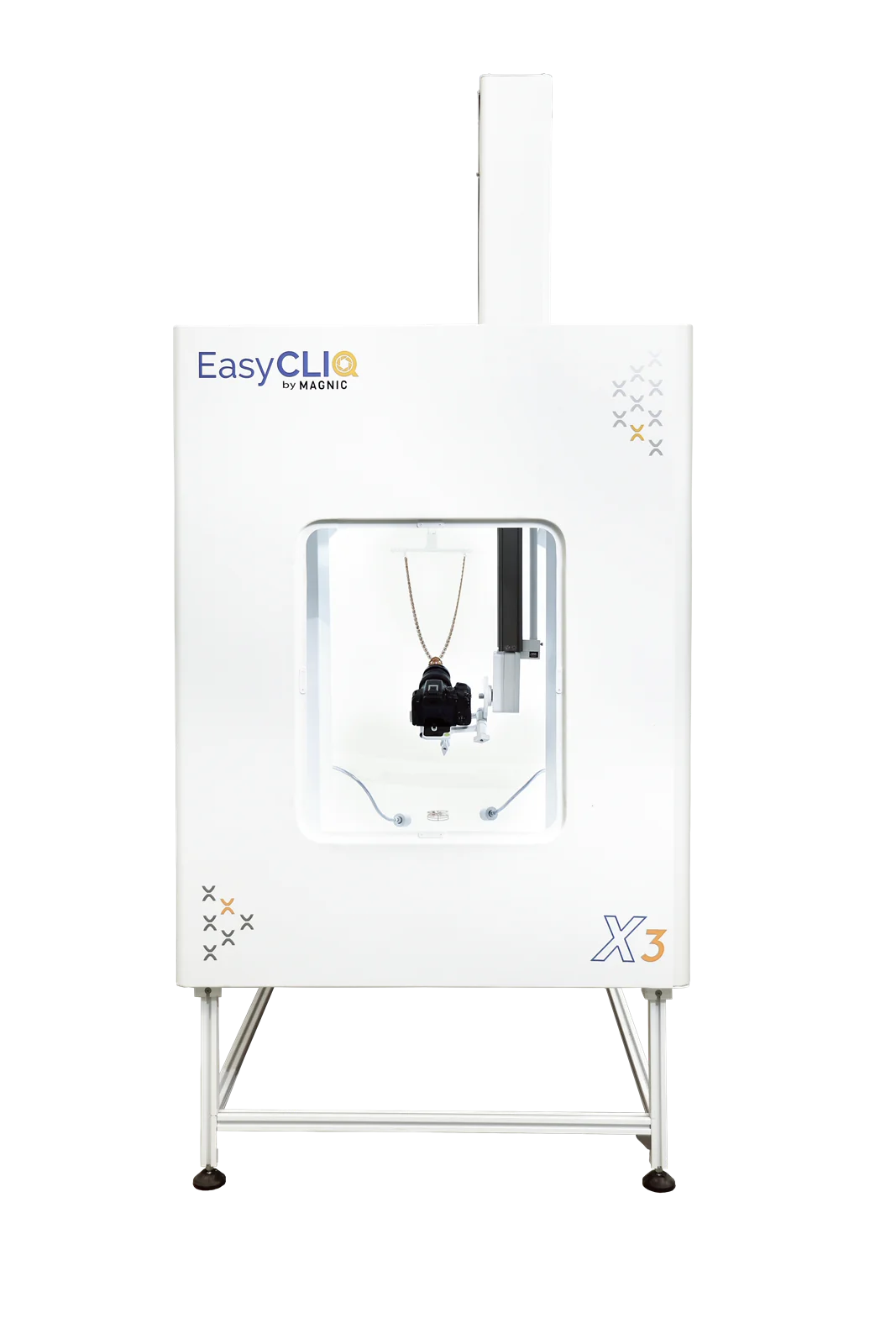
EasyCLIQ X3: ₹10,85,000
Large-format and robotic, for full-length haarams, heavy bridal sets and multi-category catalogues: a 60 cm turntable, up to 10 kg on the bottom plate and an advanced robotic camera arm.
Types of jewellery photography machines
Manual studio setup
A camera, lights, a light tent and a skilled photographer. Flexible and low-cost to start, but every shot depends on the photographer, and editing adds hours to each collection.
Lightbox or compact studio
An enclosed LED box, often with a small turntable and a phone app. Good value for rings and small pieces, but limited by the size of its opening and usually by its camera.
Automated turntable system
A software-controlled turntable and camera that capture a set of angles or a 360° spin automatically. Consistent, though the camera angle is often fixed.
360° spin studio
Built to produce smooth 360° spins and stills for catalogues, showrooms and online listings, like the EasyCLIQ HOLO.
Robotic AI studio
A complete imaging station with robotic camera movement, multi-light rigs, focus stacking, AI background removal, 360° and video in one machine, like the EasyCLIQ X1 and X3.
Important features to check before buying
Camera and lens
Megapixels matter less than the lens and the light. Check which cameras the system supports, whether it uses a proper DSLR or mirrorless camera with macro capability, and whether a camera is included in the quote. EasyCLIQ works with Canon DSLR and mirrorless cameras connected over USB.
Lighting
Look for high-CRI lights (90+) so gold and stones keep their true colour, adjustable colour temperature (for example 3000K to 6000K), several independently controlled lights, and diffusion that tames reflections on polished metal.
Capacity
Measure your largest pieces. A long haaram or a bridal set will not fit a compact lightbox, so check the turntable size, the load it takes and whether it can hang necklaces and earrings.
360° rotation and angles
Top and bottom turntables let you shoot hanging and flat pieces, and a robotic camera adds angles and video without moving anything by hand. Check the output too: 360° GIF, spin video or both.
Focus stacking and automatic focus
Focus stacking merges several frames focused at different depths, so every stone, hallmark and edge is sharp, even when shoppers zoom in.
Background removal
It should be automatic, leave clean edges on fine chains and clear stones, and export transparent PNGs for marketplaces.
Software and batch processing
Templates that save light and camera settings per product type, batch saving and output sized for e-commerce save hours every week. Ask whether the software is included or sold as a subscription, and whether key features sit behind higher tiers.
File formats and integration
Check the formats you need (JPEG, transparent PNG, GIF and video) and whether the original files are kept for retouching. EasyCLIQ outputs PNG, JPEG, animated GIF and spin video, sized for e-commerce platforms.
Service in India
Ask where the nearest service engineer is, whether spare parts are stocked in India, what the warranty covers and which AMC options exist. A machine waiting weeks for an imported part costs you listings.
How much does a jewellery photography machine cost in India in 2026?
- Entry level, from about ₹2 lakh: compact studios and lightboxes for rings, earrings, pendants and short chains. The EasyCLIQ MINI is ₹1,95,000.
- Professional, around ₹4–8 lakh: more capable studios with better lighting, 360° spin and stronger software. The EasyCLIQ HOLO is ₹4,45,000.
- Automated and robotic, around ₹8–12 lakh and above: robotic studios that photograph large bridal pieces, add cinematic video and automate the workflow end to end. The EasyCLIQ X1 is ₹8,85,000 and the X3 ₹10,85,000.
- Total cost of ownership: add taxes and freight, the camera if it is not included, software subscriptions, the editing time you still pay for and, for imported machines, shipping, customs and the cost of waiting for spare parts. EasyCLIQ software is included, with no subscription.
- For a detailed breakdown by tier, see our 2026 price guide, linked at the end of this article.
Jewellery photography machine vs a traditional setup
Initial investment: lower to start, but you pay a photographer and an editor for every collection.
Initial investment: a one-time machine cost from about ₹2 lakh, after which the main running cost is staff time.
Time: 15–30 minutes per item once setup and editing are counted.
Time: a publish-ready image in under 3 minutes per piece on EasyCLIQ.
Consistency: varies with the photographer, the day and the light.
Consistency: saved templates repeat the same light and camera settings every time.
Skills: needs a trained photographer and an editor.
Skills: staff learn quickly. EasyCLIQ training takes about an hour on the MINI and X1, and under two hours on the X3.
Image quality: can be excellent, but depends entirely on the photographer.
Image quality: controlled high-CRI lighting and focus stacking on every shot.
360° output: needs specialist equipment and extra editing.
360° output: spins and GIFs captured automatically.
Operating cost: outsourcing at, say, ₹100–300 per image adds up to several lakh rupees a year for an active jeweller.
Operating cost: no per-image fees, and EasyCLIQ software comes with no subscription.
Which machine is best for your business?
Jewellery retailers
For photographing stock at the counter or in a back room, a compact studio like the EasyCLIQ MINI is enough. Showrooms that want eye-catching 360° displays can add the HOLO.
Jewellery manufacturers
New designs need catalogue images fast. The EasyCLIQ X1 covers everything from rings to long necklaces; makers of heavy bridal sets and full-length haarams should look at the X3.
Exporters
Overseas buyers judge a design from photos and spins alone, so consistency and true colour matter most. A robotic studio like the X1 or X3 keeps every catalogue image in the same style.
Online jewellery stores
Marketplaces expect five to eight angles and a 360° spin per product. The X1 is built for that, with robotic camera angles and spin video in one pass.
Large jewellery chains
A central X1 or X3 studio can produce the catalogue for every store, with MINIs at store counters for day-to-day shots. The software and templates are the same across models.
Small businesses and start-ups
Start with the MINI at ₹1,95,000. It runs the same software as the larger models, and your saved templates carry over if you upgrade to an X1 or X3 later.
How to photograph different jewellery pieces
Rings
Stand the ring upright or at a low three-quarter angle, and add a top view of the setting. Focus stacking keeps the band and the stone sharp together.
Earrings
Shoot the pair together, then one close-up. Hanging drops from a top turntable lets them fall naturally.
Bangles and kadas
Show the outer design and the inner hallmark. A 360° spin shows the full circle in one view.
Necklaces and haarams
Hang them from a top turntable or use a bust so they drape as worn. Long haarams need a studio tall and wide enough to fit them.
Chains
Hang the chain to show its length, then take a macro close-up of the links and the clasp.
Pendants
Hang the pendant on its chain or lay it flat, and add a close-up of the bail and stones.
Diamond jewellery
Use controlled, diffused light at high CRI, leaning cooler (towards 6000K) for crisp white stones, and focus stacking so every facet is sharp.
Common buying mistakes
- Choosing on megapixels alone: for jewellery, the lens, the light and focus stacking matter more than the sensor.
- Ignoring the lighting: without high-CRI, controllable light, gold looks flat and stones lose their colour.
- Buying too small: a compact lightbox cannot fit a haaram or a bridal set, so your biggest pieces still go out to a photographer.
- No local service: an imported machine waiting weeks for a spare part costs you listings.
- Weak software: manual background removal, no focus stacking or features behind a subscription cost you editing hours.
- Not testing with your own jewellery: ask for a demo with your own pieces before you decide.
- Ignoring 360°: if you sell online, check the machine produces 360° spins and video, not just stills.
- Forgetting the workstation: check which camera and computer the system needs, and whether they are included in the quote.
ROI: how quickly does a machine pay for itself?
The simplest way to judge a machine is to compare it with what you spend on photography today. Payback in months is the machine price divided by the monthly saving, where the saving is what you now spend on photographers and editing, minus the staff time the machine needs.
Here is a worked example with illustrative numbers. Replace them with your own.
Worked example: 100 products a month
- Volume: 100 products a month with 6 images each (marketplaces expect 4 to 8), so 600 images a month.
- Current cost: outsourced photography and editing at ₹150 per image comes to ₹90,000 a month, or about ₹10.8 lakh a year.
- Investment: an EasyCLIQ X1 at ₹8,85,000 plus taxes and freight, with its software included.
- Payback: ₹8,85,000 ÷ ₹90,000 is about 10 months. After that, the saving is yours, less the staff time the machine needs.
- Smaller scale: 30 products a month at the same rates is ₹27,000 a month, so a ₹1,95,000 MINI pays for itself in about 7 months.
Final buying checklist
- Camera: which models are supported, and is one included?
- Lens: macro capability for rings, stones and hallmarks.
- Lighting: 90+ CRI, adjustable colour temperature and independent control.
- Capacity: turntable size, load and height for your largest pieces.
- Software: background removal, focus stacking, templates, batch saving and output formats, and whether it is included or a subscription.
- Automation: turntables, robotic camera, 360° spin and video.
- Warranty: what is covered, for how long, and who honours it in India.
- Installation and training: on-site, and how long until your staff are productive.
- Service: local engineers, response times and AMC options.
- Spare parts: stocked in India or imported?
- Upgradeability: can you move to a larger model without losing your settings?
- Samples: a demo on your own jewellery.
FAQ: jewellery photography machines in India
What is the best jewellery photography machine in India?
It depends on your pieces and your volume. For most jewellers and online sellers, a robotic studio such as the EasyCLIQ X1 covers rings to long necklaces with 360° spin and video. Retail counters and small businesses are well served by the compact MINI, large bridal pieces and mixed catalogues by the X3, and dedicated 360° catalogue work by the HOLO. We make EasyCLIQ, so compare it with the other systems in the table above and ask for a demo on your own jewellery.
How much does a jewellery photography machine cost in India?
Compact studios start at about ₹2 lakh, mid-range studios cost around ₹4–8 lakh, and robotic, large-format studios around ₹8–12 lakh and above. EasyCLIQ is ₹1,95,000 for the MINI, ₹4,45,000 for the HOLO, ₹8,85,000 for the X1 and ₹10,85,000 for the X3, with taxes, freight and service charges extra as applicable.
Can these machines photograph gold jewellery?
Yes. Controlled, high-CRI lighting with adjustable colour temperature keeps gold its true colour, and an enclosed studio keeps reflections on polished metal clean and consistent.
Can they photograph diamonds?
Yes. Diamonds need controlled, diffused light to show their sparkle without harsh hotspots, and focus stacking to keep every facet sharp. On the EasyCLIQ X1 and X3, ten independently controllable lights let you tune the light for white stones and coloured gems.
Can they create 360° images?
Most automated machines can. EasyCLIQ produces 360° spins as animated GIFs and spin videos, and the X1 and X3 add robotic cinematic video.
Is a DSLR or mirrorless camera required?
It depends on the machine. Some lightboxes use a phone or a built-in camera. EasyCLIQ uses a Canon DSLR or mirrorless camera connected over USB, for professional sensor quality with full automation. Check which models are supported and whether a camera is included in your quote.
Is an automated machine better than a manual setup?
For most jewellery businesses, yes: it is faster (minutes rather than 15–30 minutes per item), consistent across the whole catalogue and does not depend on a specialist photographer. A manual setup can produce excellent images, but every shot depends on the photographer and the editing time.
What machine is suitable for small jewellery businesses?
A compact studio such as the EasyCLIQ MINI at ₹1,95,000. It runs the same software as the larger models, so your saved templates carry over if you upgrade to an X1 or X3 later.
Choosing with confidence
The best jewellery photography machine is the one that fits your largest pieces, gives true colour on gold and stones, produces the angles and 360° spins your channels need, and is backed by service you can reach quickly. Price matters, but so do software, capacity and support over the years you will use it.
Book a free demo and we will photograph a piece from your own collection, so you can compare the results before you decide.